A HISTORY OF BELARUS: A NON-LITERARY ESSAY THAT EXPLAINS THE ETHNOGENESIS OF THE BELARUSIANS by Lubov Bazan
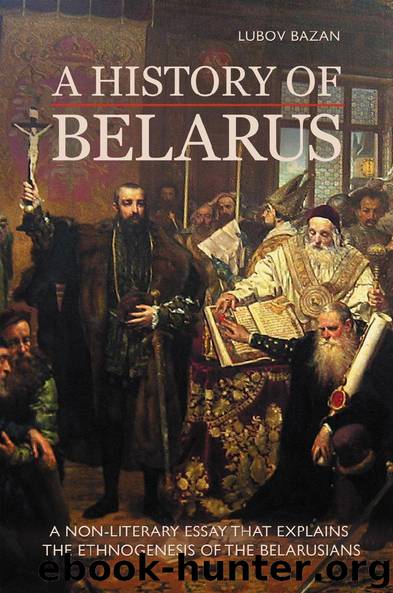
Author:Lubov Bazan [Bazan, Lubov]
Language: eng
Format: epub
Publisher: Glagoslav Publications
CHAPTER 9
The Division of the Polish-Lithuanian Commonwealth (1772-1795)
In 1772 the first division of the Polish-Lithuanian Commonwealth took place between Russia, Prussia and Austria. Russia took the eastern part of Belarus with the cities Polotsk, Vitebsk, Orsha, Gomel and Mogilev. Russian diplomats demanded that the Polish Sejm meet in Grodno and recognise the voluntary transfer of these lands to Russia. On the one hand the bribery among the deputies, and on the other hand their utter passivity contributed to the fact that this unprecedented demand was in fact satisfied.
The first division of the Polish-Lithuanian Commonwealth did not bring the Polish barons to their senses, who were in a constant state of competition with one another. But they did allow some policy changes in relation to the Orthodox Church. In 1783 the Polish Sejm agreed to open a Belarusian eparchy within the Polish-Lithuanian Commonwealth. Archimandrite Viktor Sadkovskiy was appointed as Orthodox bishop in Poland and he fully supported the Russian authorities and maintained strong pro-Russian sentiments. Russia continually made use of any political complications to interfere in the internal affairs of Poland.
After the first division of Poland three parties formed. One of them, the royal party, sought specific reforms in society, but in cooperation with Russia. By this time, paradoxical as it may sound, there were a large number of officials in Poland’s government who received salaries from Russia, including the last king of Poland, Russia’s protégé Stanisław Poniatowski. At the head of the second party was hetman Ksaveriy Branitskiy (1731-1819). This party also consisted of members supporting closer cooperation with Russia, but was against the king and his entourage. The third party was markedly anti-Russian and wanted independence for Poland, but it was unable to develop any ideas to save and reform the collapsing nation.
From 1788 to 1792 four Sejm sessions took place in Warsaw, at which a substantial majority of deputies were opponents of Russia. They formed a large group of “patriots” led by Tadeusz Kościuszko (1746-1817) and advocated the need for urgent political reform. They had a chance of success as Russia at the time was occupied in a war with Turkey and Sweden, and it was for a time unable to oversee its guardianship of Poland. A large influence on the Sejm ’s work came from the Prussian Note, a statement from the Prussian ambassador that Prussia (which had only just been involved in the first division of Poland and had already broken off a piece of the pie for itself) was prepared to enter into an alliance with Poland against Russia. This inspired many Sejm deputies who were opposed to Russia. Despite the opposition and inability to reach a consensus on many issues, on 3 May 1791 the Sejm succeeded in adopting a new Constitution which opened the way to move away from the crisis and transition to a bourgeois-democratic developmental path. The new Constitution finally provided for the succession, rather than the election, of the monarch, definitively abolished the “right of veto” and regulated the activities of the state executive.
Download
This site does not store any files on its server. We only index and link to content provided by other sites. Please contact the content providers to delete copyright contents if any and email us, we'll remove relevant links or contents immediately.
| Africa | Americas |
| Arctic & Antarctica | Asia |
| Australia & Oceania | Europe |
| Middle East | Russia |
| United States | World |
| Ancient Civilizations | Military |
| Historical Study & Educational Resources |
Room 212 by Kate Stewart(5198)
The Crown by Robert Lacey(4877)
Endurance: Shackleton's Incredible Voyage by Alfred Lansing(4861)
The Iron Duke by The Iron Duke(4418)
The Rape of Nanking by Iris Chang(4274)
Joan of Arc by Mary Gordon(4166)
Killing England by Bill O'Reilly(4060)
Say Nothing by Patrick Radden Keefe(4057)
I'll Give You the Sun by Jandy Nelson(3512)
Shadow of Night by Deborah Harkness(3429)
Hitler's Monsters by Eric Kurlander(3410)
Eleanor & Park by Rainbow Rowell(3267)
Blood and Sand by Alex Von Tunzelmann(3255)
Mary, Queen of Scots, and the Murder of Lord Darnley by Alison Weir(3251)
Darkest Hour by Anthony McCarten(3182)
Margaret Thatcher: The Autobiography by Thatcher Margaret(3128)
Book of Life by Deborah Harkness(2992)
Red Famine: Stalin's War on Ukraine by Anne Applebaum(2977)
The One Memory of Flora Banks by Emily Barr(2909)
